Quick answer
Under the CDC Model Aquatic Health Code, commercial pools need at least 1.0 ppm free chlorine (2.0 ppm if cyanuric acid is used) and no more than 10 ppm, pH between 7.0 and 7.8, combined chlorine below 0.4 ppm, and cyanuric acid at or below 90 ppm. Spas need at least 3.0 ppm free chlorine and a maximum of 104°F.
- Free chlorine: 1.0–10.0 ppm pools (2.0 min with CYA); 3.0 min spas.
- pH: 7.0–7.8; close below 6.5 or above 8.0 (MAHC).
- Combined chlorine: keep below 0.4 ppm.
- Cyanuric acid: 90 ppm maximum (MAHC).
Commercial pool chemical levels chart
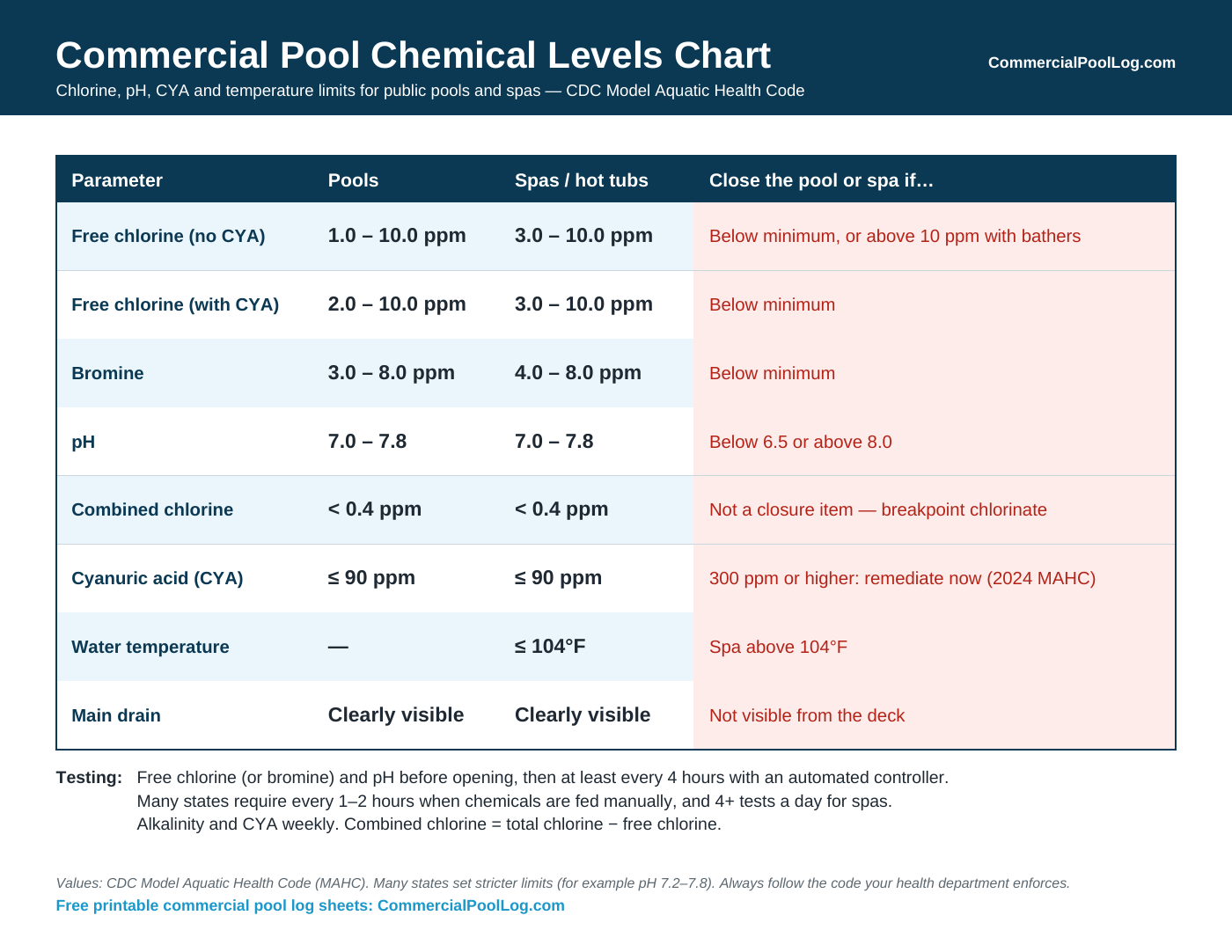
| Parameter | Pools | Spas / hot tubs | Close the venue if… |
|---|---|---|---|
| Free chlorine (no CYA) | 1.0 – 10.0 ppm | 3.0 – 10.0 ppm | Below minimum or above 10 ppm |
| Free chlorine (with CYA) | 2.0 – 10.0 ppm | 3.0 – 10.0 ppm | Below minimum |
| Bromine | 3.0 – 8.0 ppm | 4.0 – 8.0 ppm | Below minimum |
| pH | 7.0 – 7.8 | 7.0 – 7.8 | Below 6.5 or above 8.0 |
| Combined chlorine | < 0.4 ppm | < 0.4 ppm | — (take corrective action) |
| Cyanuric acid | ≤ 90 ppm | ≤ 90 ppm | CYA : FC ratio above 45 : 1 |
| Temperature | — | ≤ 104°F | Above 104°F |
Balance parameters (not usually closure items)
- Total alkalinity: commonly 60–180 ppm; buffers pH.
- Calcium hardness: commonly 150–1,000 ppm depending on surface and code.
- Total dissolved solids: monitor; drain and dilute when high.
- ORP (if used): controllers typically target 650–900 mV, verified by manual tests.
Out of range? The pool chemical calculator gives the chlorine, acid, soda ash, bicarbonate, calcium or stabilizer dose for your pool volume.
Why these limits exist
Free chlorine kills germs, but its strength depends on pH: at pH 7.2 far more of it is in the fast-acting hypochlorous acid form than at pH 8.0. Cyanuric acid protects chlorine from sunlight but also slows it down, which is why the MAHC raises the chlorine minimum when CYA is present and caps CYA at 90 ppm. Combined chlorine (chloramines) causes the "chlorine smell", eye irritation, and indoor air-quality problems — see combined chlorine & breakpoint chlorination.
Frequently asked questions
What is the minimum chlorine level for a commercial pool?
1.0 ppm free chlorine under the CDC MAHC, or 2.0 ppm if the pool uses cyanuric acid. Spas require at least 3.0 ppm. Your state may set different minimums.
What is the maximum chlorine level for a public pool?
10 ppm free chlorine while bathers are present under the MAHC. Many states use the same 10 ppm cap.
What pH should a commercial pool be?
Between 7.0 and 7.8 under the MAHC; many states require 7.2–7.8. Close the pool if pH falls below 6.5 or rises above 8.0 under MAHC imminent-health-hazard rules.
What is the maximum cyanuric acid in a commercial pool?
90 ppm under the 2023 MAHC. Some states allow more; others ban stabilizer in indoor pools and spas.
This page is an educational summary, not legal advice. Pool and spa codes differ by state and county and change over time — always confirm requirements with the health department that inspects your facility.